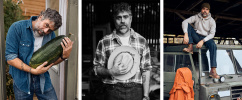
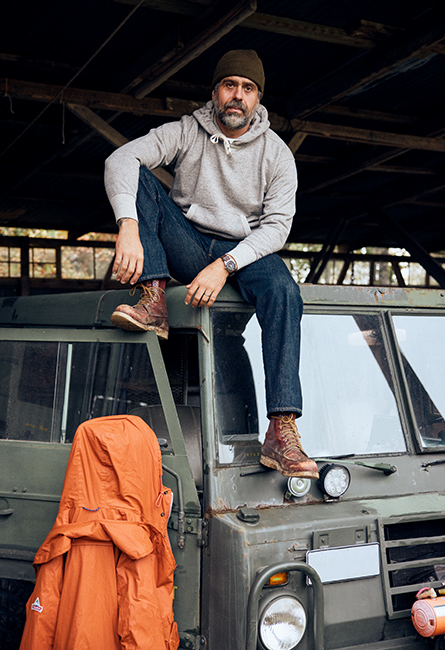
Arriving at the farmhouse that
Kalle Zakari Wahlström and wife
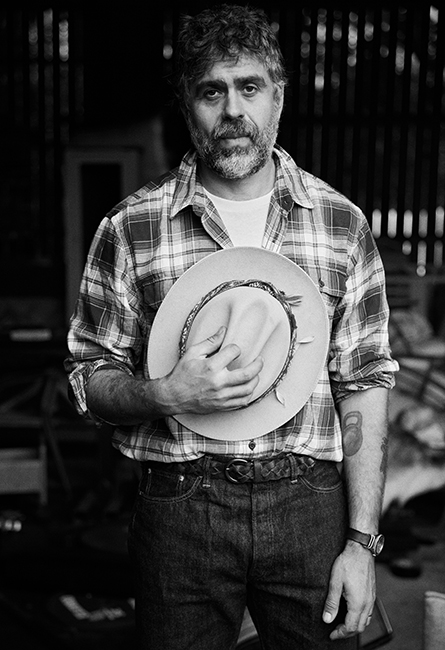
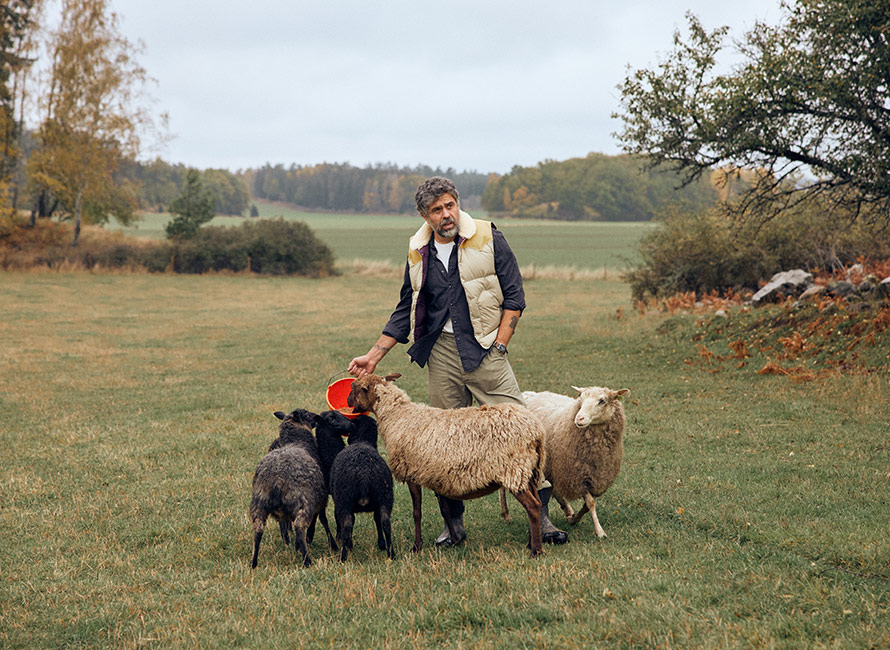
Brita purchased a just a few years previously, the Swedish adman-turned-TV-presenter greets us with his hands full of tools. ‘I just like to walk around with them for no particular reason’, he says jokingly before returning them to their rightful place in his workshop. We quickly learn that Kalle has become somewhat enamoured with the clothes he will be wearing during the photoshoot and that his interest in the world of clothing, and clothing of American and Japanese origin in particular, began around 10 years ago. 'It felt like I'd finally found a look that I hadn't really...' he begins, before being drowned out by a chorus of ducks, dogs, and sheep. By taking on the farm, Kalle and his family have, in theory at least, become almost fully self-sufficient. Were it not for the rest of his family’s refusal to eat meat and potatoes every day, they could be totally self-reliant, he suggests while opening the door to the main house, where we are greeted by the cosy warmth of a tiled stove, the smell of coffee, and the family gun dog Kerstin. We make ourselves comfortable on the sofa before continuing our interview, under the watchful eye of a mounted boar’s head.
What did you do before you began presenting?
– I worked in advertising, more specifically as a copywriter at a PR firm called Great Works. I worked together with
David Sundin and
Kristoffer Triumf, among others, both of whom have switched career paths since (now a comedian and journalist respectively, ed.). Before that, I edited radio ads with my sister at the production company Delorean. I’ve done various other things, but it was after launching my blog
Stark som en björn, snabb som en örn (‘Strong as a Bear, Fast as an Eagle’) that my TV career began to take off. Someone thought it would be a good idea to make a TV show based on the blog, and someone at SVT (the Swedish public service broadcaster, ed.) agreed. The result was the show
Svett och Etikett (‘Sweat and Manners’), which aired for the first time in 2014. Since then, I’ve just been doing this – whatever ‘this’ is.
You've presented seven different programmes to date. Do you still find it exciting?
– Yes! It turns out it was what I was always meant to do. It wasn’t anything I’d planned, and I’ve been lucky in that, in the years since
Svett och etikett first aired, I've been able to do things I previously could only dream of. We’ll soon be wrapping up filming on season three of
Help! We Bought a Farm! and I’m not really sure what I’ll do next. Well, we’re in negotiations about the next project already. It feels a bit unprofessional to discuss plans that aren’t definite yet, but I just found out about a project in Mozambique where they’re trying to save rhinos from poachers. I’d like to create something around that.
What was it like to move from the city to a farm deep in the countryside?
– I actually grew up in this area, about 10 kilometres away. When I was little, I was constantly wanting to go into town, where they at least had tarmac on the roads. Both of my parents are academics from Stockholm, but since they are classic, green-minded contrarians, we ended up here. When I was in my late teens, I used to go to Stockholm all the time – I worked there, moved there, partied there, and did all the other stuff people of that age like to do. I became a father at the age of 25, at which point I didn’t really want to live in the city anymore, but I was stuck there because of work and everything. I don’t think humans are meant to have everything served on a plate, I believe it’s good for us to work hard for what we get. Take food, for example – it’s much more satisfying to eat food you’ve grown yourself. Living this way somehow brings you closer to everything.
"Living this way somehow brings you closer to everything"
Was Brita just as eager to move as you were?
– Brita is a country girl too, but she likes city life a bit more than me. She’s more of an extrovert, energised by meetings and social events. I find it a bit draining, so I’ll probably go and have a nap when we’ve finished here. That’s not to say that she doesn’t like living here, but she’s maybe not quite as into it as I am. I was thinking about that the other day actually, giving up and moving back into the city, but I would’ve been so damn bored. Like, what would I do with myself there?
Maybe that could be your next TV show?
– Ha-ha, exactly! It could be called ‘Isolated’ or ‘Prisoner in my own home’. That’s the kind of thing that makes you start listening to vinyl through ridiculously expensive speakers or becoming a raging alcoholic who sends hate-mail over the internet, or something.
Let's change the subject. How would you describe your relation to your clothing?
– When I was young, I thought experimenting with clothing was great fun. On a student exchange to the US, for example, I wore a skirt over trousers on my first day at high school, as a kind of statement. Weirdly enough, most of the other students didn’t seem to care. When I became a dad, I got interested in other things, and clothing took a back seat, so to speak. I think it was in 2010 or somewhere thereabouts that, completely out of the blue, my interest in clothing was reignited. I felt like I’d found a style for people like me, something that I’d never felt before. A style for bearded, muscly men who like to think of themselves as heroes, or something like that – a kind of American dad-fashion. I like the idea of clothes that still look like they used to. A long time ago, someone created their ideal jacket, and I like that it still looks the same as it always has. I’m also really into American culture – music, and books about the struggles of American men, and my interest in clothes reflects that. I’m a struggling man too, at least when it comes to this farm, so I’m sure I’ve found the right style for me.
"I like the idea of clothes that still look like they used to"
I read somewhere that your dad set fire to one of your shirts when you were a kid, just because it said ‘USA’ on it. Has your childhood influenced how you dress?
– Well, my taste in clothing is very Americanised, so maybe that’s why, ha-ha. No, I think that’s a bit far-fetched. I think my interest in clothing comes more from reading Cormac McCarthy and listening to Bruce Springsteen, to be honest.
Do you have an item of clothing that is particularly special to you?
– The most obvious example would have to be my Carhartt trousers – the
B01 model. People ask me about them on Instagram four or five times a week. I actually just had to throw away a pair I bought 20 years ago, but I still have several more, in various states of disrepair. Clothes look best when they’re a bit worn, but it takes a hell of a long time to wear them in. On the other hand, you shouldn’t be thinking ‘I need to start wearing these in’. I believe you should instead own and wear them for a long time. I bought a motorcycle jacket from Eastman Leather, which I’m hoping will last long enough for it to be handed down to my kids, with all the wear and patina coming from me. It’s more or less the same idea that led me to buy this farm – somewhere for future generations of the family to come together. That’s what family farms are for, and the same goes for jeans, for example. There has to be someone who bought them to begin with and who wore them to perfection.
Do you prefer to buy new rather than vintage so you can wear them in yourself?
– Of course! I mean, I do sometimes buy vintage, but it feels like cheating in a way. I think it’s crazy to buy a pair of pre-worn jeans. They’re going to last a lot longer if they’re in brand new condition to begin with.
Has your style changed since you left Stockholm?
– Yeah, I think I put a bit less thought into it. A bit more functional - rubber Wellingtons instead of Japanese boots. More head lamp, less WWII cap.
You and Brita are in the process of launching your own lifestyle brand. Tell us more!
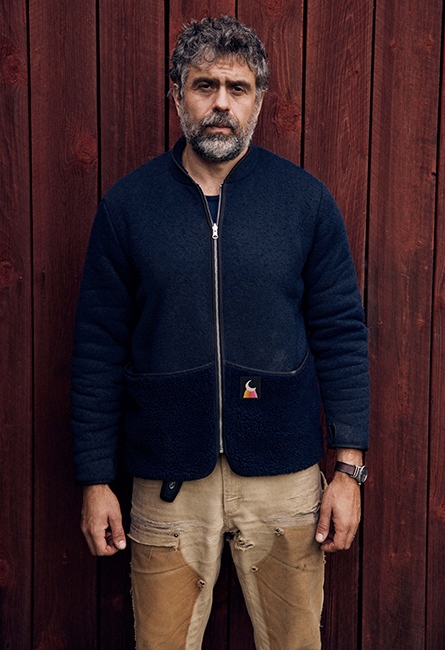
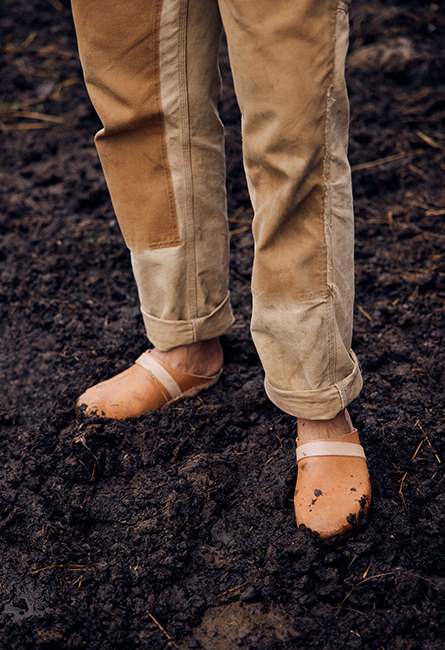
– We are! The brand is called Kärret, just like the farm. We’re always being asked what we use and wear, so it seemed like a fun idea to produce something of our own. Both Brita and I have a very particular style, and wear clothes that suit our life here. Amongst other things, we’ll be offering wooden clogs and a fleece farmer jacket – think 1970s elk hunter. The jacket has stupidly large pockets, which is very practical – there’s room for puppies, potatoes, eggs, even children. There’s room for anything in those pockets.
Wooden clogs and a 'Farmer Jacket' from Kärret.
Apart from your TV work and new brand, what else have you been up to?
– We just launched our ‘prepper kit’. I have a podcast called
I väntan på katastrofen (‘Awaiting Catastrophe’) which is all about preparedness. Most people today are pretty detached from the source of their food and heating, for example. The toilet paper panic at the start of the pandemic made it painfully obvious that people buy what they need for the day and don’t keep a stock of food and other essentials at home. With the kit and the podcast, we’re aiming to get people to arm themselves with a knowledge of self-sufficiency, to teach them that you can fix a lot of things yourself. For example, I just disconnected the radiators here since the plumber couldn’t get here until next week. It’s not that hard, and the boost it gives to your self-confidence is incredible. Basically, I want people to realise they can do things themselves. Also, everyone should have at least a week’s worth of food at home, but hardly anyone does. It doesn’t make any difference how much pasta I have in my cupboards since it’s all going to go to hell anyway if something happens, because no-one else has anything to eat. So that’s why we put together this kit with enough food for one week.
So, last but not least, if you could recommend whatever you want to our readers, what would it be?
– I’d tell them to exercise hard, grow something, and meditate.
Oh, do you meditate a lot?
– No, but I wish I did!